

After the Tennessee Department of Corrections botched Tony Carruthers’ execution in May, he was given ibuprofen and escorted back to his cell, like it was a regular day.
In a way, it was just another day on death row. Carruthers is one of 41 people awaiting execution in Tennessee. He was prosecuted in Shelby County, and so were most others. State records show people who were convicted in Shelby County make up a majority of the state’s death row population.
Twenty-one death row prisoners are from Memphis. All are men who were convicted of first-degree murder. One is Vietnamese, four are white, and 16 are Black, including Carruthers. People from Shelby County make up 51% of the state’s death row population while accounting for only 12% of the state’s overall population.

“I think there’s a whole lot of layers to that,” said Stacy Rector. She is the executive director of Tennesseans for Alternatives to the Death Penalty.
Rector pointed to a study published in 2023 by the Death Penalty Information Center. The study — titled “Doomed to Repeat: The Legacy of Race in Tennessee’s Contemporary Death Penalty” — shows Shelby County is one of the top three counties (of similar populations in the United States) that condemns people to death.
Data also shows more people from Shelby County have been sent to death row than anywhere else in Tennessee. An analysis by MLK50: Justice Through Journalism shows at least 77 men and women from Shelby County have been sentenced to death since the 1970s, when the U.S. Supreme Court decided capital punishment was constitutional.
To put it another way: nearly one in three people sent to death row in the state have been from Shelby County — an area with a majority Black population where nearly one in five people are poor.
Rector referenced local politics, crime rates, history, the legacy of lynchings and the power of prosecutors as root causes for inequities in death sentencing.
“All of that comes into play in Memphis,” Rector said.
Another fact indicates a different issue with these sentences. Of the 77 people sentenced to death in Shelby County since the 1970s, more than half of those cases resulted in a resentencing, a commutation or a retrial, according to the report by the Death Penalty Information Center. Most of those cases involved Black defendants.
“This gets back to issues about (whether a defendant can) afford a proper defense. Did (they) have a jury of (their) peers? We know there are cases out of Shelby County (with) all-white juries,” Rector said. “If a person does not have proper counsel and proper resources for investigation, so many things can go wrong at (trial).”
‘Serious mistakes … at every stage of death penalty cases’
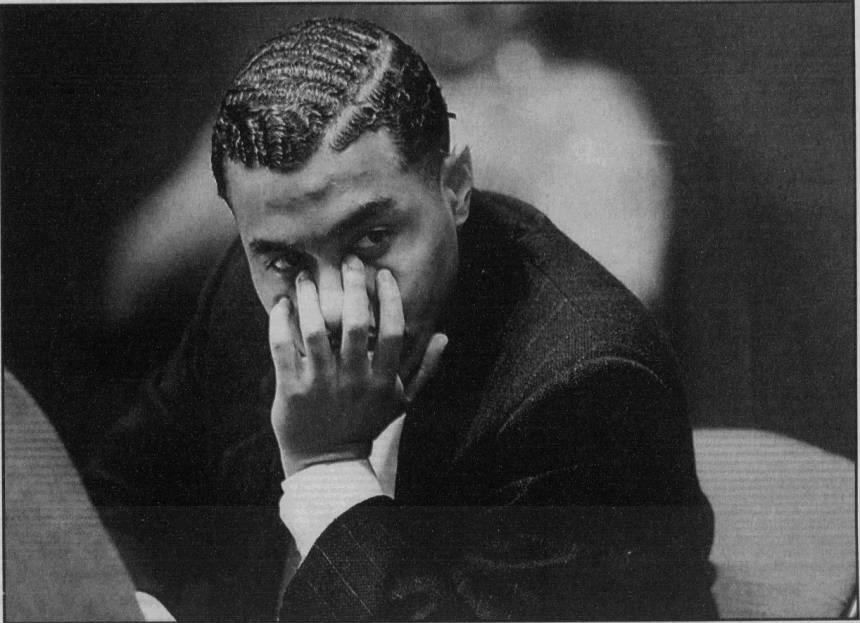
More than 30 years ago, Carruthers was sentenced to death for a triple murder in South Memphis.
Reporting by The Intercept shows it’s been an “open secret” that prosecutors relied on a paid informant’s false testimony to convict Carruthers. He was sentenced in the 1990s — an era marked by “law and order” and “tough on crime” norms. Decades later, no physical evidence has linked Carruthers to the crime, and DNA and fingerprints in the case remain untested.
Since his conviction, Carruthers has maintained his innocence, and his family stands with him. “We’ve been saying he did not do this,” Carruthers’ sister, Tonya Carruthers Hervey, said. “But people have not been listening.”

For years, capital defense attorneys have filed appeals to get the courts to review Carruthers’ case with the hopes of resentencing, being granted a new trial, staying the execution or testing DNA evidence. Although their attempts have been unsuccessful so far, it’s not uncommon for a person’s death sentence to result in a different outcome.
Since the 1990s, one out of every 50 cases in which people were sentenced to die has been overturned due to evidence of innocence, reporting by The Marshall Project shows. Across the United States, more than 2,000 people are on death row.
“We shouldn’t be surprised because we see serious mistakes by state officials at every stage of death penalty cases, beginning with prosecution,” said Robin Maher, executive director of the Death Penalty Information Center.
‘A thorn in the flesh of the death penalty system’
Prosecutors have tremendous power in the criminal justice system. Part of their job is to lead criminal cases through trial, negotiate plea deals with people accused of crimes and to recommend prison sentences for people convicted of crimes.
Usually, the jury is responsible for deciding the sentence, but the death penalty can only be recommended for defendants convicted of first-degree murder.
In Memphis, prosecutors work for the Shelby County district attorney. The DA is a county-wide elected position, and the person remains in office for 8 years — the longest term in the U.S. for an elected prosecutor.
Currently, Steve Mulroy, a so-called “progressive prosecutor,” is in the fourth year of his term.
Before Mulroy, Amy Weirich was DA from 2011 to 2022. Bill Gibbons had the seat from 1996 to 2010.
Before Gibbons, John Pierotti served a six-year term as DA, beginning in 1990, and his predecessor, Hugh Stanton Jr., had been in office since 1974.
According to an MLK50 analysis of crime data reported by the FBI, yearly homicide rates were highest during Weirich (2011-2022) and Pierotti’s (1990-1996) terms. But during Gibbons (1996-2010) and Pierotti’s terms as DA, there were more than one death sentences per 100 homicides — a higher rate than Weirich’s despite a higher homicide rate during her term in office.
The lowest rate of death sentencing occurred during Weirich’s 11-year term, while the highest rate of death sentencing occurred during Pierotti’s six-year term.
Death sentencing and homicide rates are unavailable for the years Stanton was in office (1974-1990) because FBI data only goes back to 1985. However, 34 people were sentenced to death during Stanton’s 16-year term — the most out of all four district attorneys.
“(We) had a district attorney’s office in Memphis, historically, that used (the death penalty) a lot. That comes out of a certain history and culture,” Rector said.

A study, titled “Tennessee’s Death Penalty Lottery,” published in the Tennessee Journal of Law and Policy in 2021, identified prosecutorial discretion — and misconduct — as a reason why so many death penalty cases have come from Shelby County. Researchers described prosecutorial misconduct as “a thorn in the flesh of the death penalty system.”
A 2017 study by the Fair Punishment Project showed the “Shelby County district attorney’s office had the highest rate of prosecutorial misconduct findings in the nation” — across all cases, not just those involving the death penalty. The study cited Weirich, who was known for being “tough on crime” during her term. According to the 2021 legal study, Shelby County was the only Tennessee county to send people to death row from 2012 to 2017, during Weirich’s DA tenure.
The political environment of Shelby County “may encourage” prosecutors to pursue the death penalty, the study states. While prosecutors say they use it in “worst of the worst” cases, it’s also often used “to secure plea bargains in lesser sentences.”

Mulroy, Shelby County’s current DA, pursued the death penalty in Ezekiel Kelly’s 2022 mass-shooting case, but Kelly entered a plea agreement and was sentenced to life in prison. Mulroy’s office also pursued the death penalty in Cleotha Abston’s 2022 kidnapping and murder of a Memphis woman. Abston pleaded guilty, and he received a life sentence instead.
In Tennessee, a life sentence can span from 40 to 60 years, or a person can be imprisoned until death — a life without parole sentence. Death row prisoners in Tennessee await their execution for an average of 26 years. Collectively, they have spent more than 1,000 years on death row.
The two cases in which Mulroy sought the death penalty were some of the highest-profile cases in recent years, but the DA does not appear to be regularly pursuing death sentences. However, Shelby County prosecutors could seek the death penalty in the case of a man who was charged with first-degree murder for allegedly kidnapping and killing his 3-year-old son in July. A spokesperson said no decision had been made.
“(Pursuing the death penalty) is a grave decision involving a punishment I’ve publicly opposed as a policy matter. But as DA I must enforce the law despite personal opinion,” Mulroy wrote in a newsletter in 2023.
‘The misuse of power’
David Richardson is a 36-year-old man from Memphis who is serving a life sentence at Turney Center Industrial Complex in Only. He is a two-time president of his prison’s chapter of the Lifer’s Club, a group of nearly 80 members. He spends his days mentoring other men since “a lot of the difficulty of prison is the feeling of being forgotten,” Richardson said. He also works on suicide watch, keeping an eye out for other men in prison who may want to harm themselves.
When Richardson heard about Carruthers’ scheduled execution date in May, he learned that one of his suicide watch coworkers knew Carruthers. Richardson said his coworker had been resentenced to life and removed from death row.
Most defendants sentenced to death in Shelby County have been resentenced to life or a lesser sentence. This means the courts have repeatedly found flaws in the county’s death penalty cases — from arrest, investigation and trial to quality of defense representation and jury selection.
Jason Gichner, executive director of the Tennessee Innocence Project, said his office receives more case review applications from Shelby County than anywhere else in the state.
“Some of the concerns about the criminal legal system in Memphis for the last 30 years are not unique to the death penalty space,” Gichner said. “There’s a consistency across the board that demands that we (look) most critically at cases with finality, like a death sentence … if you get it wrong, you don’t get to go back and fix that.”

Out of an instinct to build solidarity with Carruthers, Richardson said he started a petition in May to ask the state to pause the execution and review Carruthers’ case. In the days leading up to the execution, Richardson collected about 280 signatures. He said he could’ve gotten hundreds more signatures if half the prison wasn’t on lockdown at the time.
“People in prison have a store of energy. No matter how long we are here, we are ready to invest that energy,” Richardson said. “I was asking people to stand in solidarity and say this execution should not happen if there’s a possibility that evidence could clear him.”
Gichner agreed. “I cannot think of any good reason why you wouldn’t (do) DNA testing that could prove that they are, in fact, innocent. We should do it always, every single time.”
But that didn’t happen.
Instead, TDOC spent more than an hour trying to give Carruthers a lethal dose of pentobarbital and failed. Gov. Bill Lee signed a reprieve on May 21, pausing Carruthers’ planned execution for one year. Since then, the public’s attention has been on the state’s execution protocol.
“We shouldn’t be in a place in this state, in this country, in 2026 where we’re botching executions to the point where they’re effectively torture, and that’s where we are,” Gichner said.
Meanwhile, Carruthers remains incarcerated and is experiencing mental and medical health issues, his family says.
Since May, Carruthers’ attorneys and Republican state lawmakers have asked the state to pause this year’s scheduled executions until all issues are resolved. Carruthers’ sister filed a “medical malpractice and torture” complaint against TDOC. Several faith leaders and medical professionals across Tennessee have also asked the state to pause executions.
However, Lee has refused to review or update TDOC’s lethal injection protocol, and the state is expected to move forward with the Aug. 13 execution of Darrell Hines, a 66-year-old man who is partially paralyzed after a series of strokes, his attorneys said.
“The form of power that incarcerated people are most familiar with is the misuse of power,” said Richardson. His sentence will end in 2283.
Editor’s note: An earlier version of this story incorrectly stated the charges against Cleotha Abston. The story has been updated to reflect the correct charges.
Brittany Brown is the public safety reporter for MLK50: Justice Through Journalism. Email her at brittany.brown@mlk50.com
This story is brought to you by MLK50: Justice Through Journalism, a nonprofit newsroom focused on poverty, power and policy in Memphis. Support independent journalism by making a tax-deductible donation today. MLK50 is also supported by these generous donors.